Ithaca
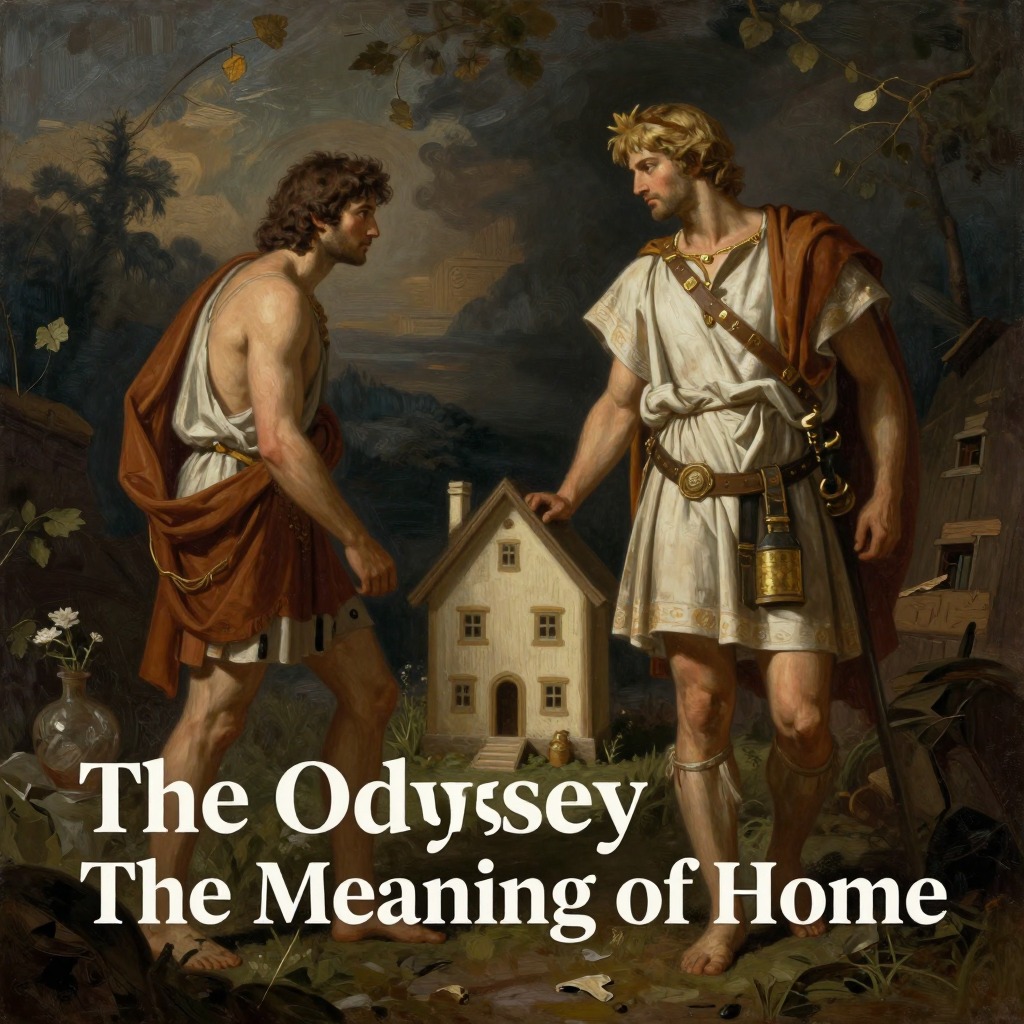
Ithaca, the rocky island kingdom of Odysseus, is the fixed point around which the entire Odyssey revolves. It is the object of every prayer, the goal of every voyage, and the standard against which all other lands are measured. More than a mere setting, Ithaca is the embodiment of home, legitimacy, and the natural order that has been disrupted by the suitors' invasion of Odysseus's household. The poem's geography, politics, and emotional weight all converge on this single, rugged island, making it the indispensable center of the epic's moral and narrative universe.
Geography and Character
Ithaca is described as a rugged island, not a place of broad plains or horse-rearing pastures. As Telemachus tells Menelaus, Ithaca has "no open fields nor racecourses, and the country is more fit for goats than horses" . This characterization is echoed by Odysseus himself, who calls it "a rugged island, but it breeds brave men" . The island lies "squat on the horizon, all highest up in the sea towards the sunset" , a description that matches the view of the island of Marettimo from Mount Eryx in Sicily, supporting Samuel Butler's controversial theory that the poem's geography was drawn from that region. The island's specific landmarks are carefully delineated: the haven of the old merman Phorcys, with its overarching cave sacred to the Naiads and a large olive tree at its head ; the wooded mountain Neritum ; and the fountain Arethusa near the Raven rock . These features are not merely decorative; they serve as crucial points of recognition when Odysseus finally returns, allowing Athena to prove to him that he is indeed home (E00729-E00731).
Political and Social Center
Ithaca is not just a landscape but a political entity, a kingdom with its own assembly, chieftains, and social hierarchies. The poem opens with the suitors, "the chiefs from all our islands, Dulichium, Same, and the woodland island of Zacynthus, as also all the principal men of Ithaca itself" (E00079-E00080), consuming Odysseus's estate. The political dimension is made explicit in the assembly Telemachus convenes, where he declares that his father "was chief among all you here present, and was like a father to every one of you" . The suitors' waste is thus not merely a domestic problem but a political crisis, a violation of the proper order of the kingdom. The house of Odysseus itself is a complex structure with an outer court, a cloister where the suitors feast, a storeroom for treasure, and an upper chamber for Penelope. The storeroom, where "his father's treasure of gold and bronze lay heaped up upon the floor" and where "casks of old, well-ripened wine" were stored , represents the material wealth and continuity of the household that the suitors are devouring.
The Goal of Nostos
Ithaca is the object of an almost unbearable longing. Odysseus, detained by Calypso on Ogygia, is described as "yearning to see if it were but the smoke leap upwards from his own land" . This image of the smoke from his own chimneys becomes a powerful symbol of home and belonging. Even Calypso, who offers him immortality, cannot compete with the pull of Ithaca: "there is nothing dearer to a man than his own country and his parents, and however splendid a home he may have in a foreign country, if it be far from father or mother, he does not care about it" . The entire middle section of the poem, Odysseus's wanderings, is structured as a series of obstacles that delay his return to this one desired place. The Phaeacians finally convey him home in a magical ship, and he wakes on Ithaca to find it disguised by Athena's mist, so changed that he does not recognize it and must be convinced by the goddess pointing out the familiar landmarks of Phorcys' haven and the cave of the Naiads (E00717, E00729-E00731).
Site of Reckoning and Restoration
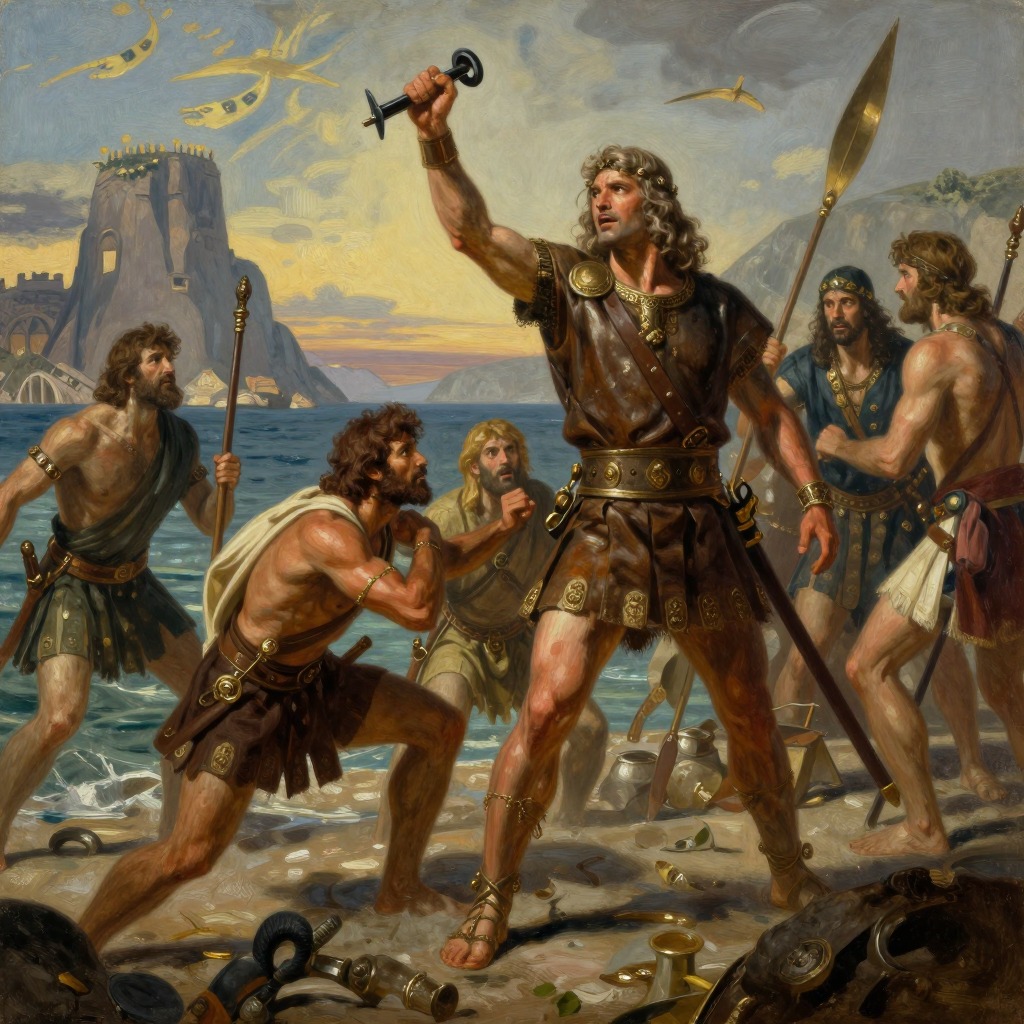
Once Odysseus is home, Ithaca transforms from a goal into a battlefield. The palace, which had been the scene of the suitors' prolonged abuse of xenia, becomes the site of their slaughter. The contest of the bow, the killing of the suitors, and the purification of the house all take place within its walls. The final book extends the restoration to the wider island: Odysseus visits his father Laertes on his farm, and a battle with the relatives of the slain suitors is averted only by Athena's intervention, which establishes a lasting peace covenant . Ithaca is thus not only the place Odysseus returns to but the place where order is violently reasserted and a new, peaceful era begins. The island's ruggedness, which once seemed a limitation, now stands as a fitting home for a king who has proven his mettle through suffering and cunning, and for a people who, after the purging of the suitors, can once again live under just rule.